Strategies of Survival
Why do we disconnect from ourselves in the first place?
In many cases, children come to believe that they are the problem rather than risk experiencing their caregivers as unsafe, unavailable, or unable to meet their needs. Maintaining attachment is essential for survival, so children often organize their experience in ways that preserve connection, even at the expense of their own authenticity.
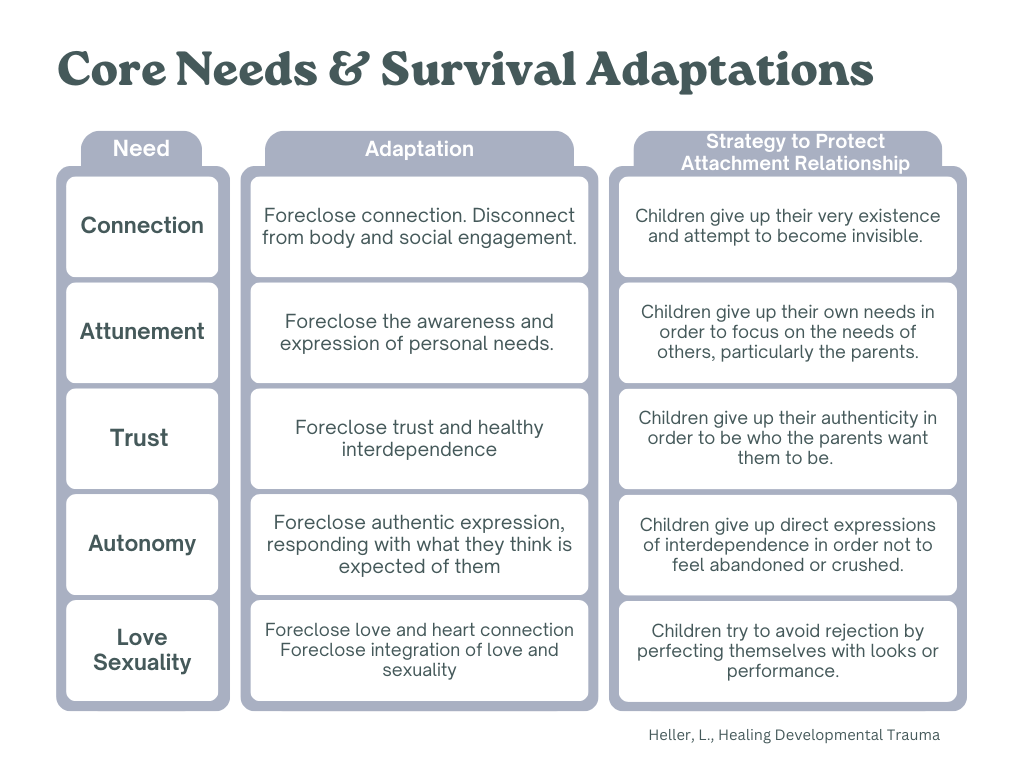
The charts shown here describe core developmental needs and the adaptive survival strategies that can emerge when those needs are not consistently met, respected, or supported. Because children naturally experience themselves as influencing what happens around them, they often internalize beliefs about who they are based on these experiences—for better or for worse.
When the environment is unable to adequately support a child's developmental needs, children often disconnect from their own reality, body, emotions, and inner knowing in order to preserve attachment and protect themselves from overwhelming physiological and emotional distress. Over time, these adaptations become deeply ingrained patterns in the brain and nervous system, shaping enduring shame-based identities and the pride-based strategies that develop alongside them.
These patterns are not signs of pathology or weakness. They are brilliant adaptations that once served to protect us. Therapy is not about getting rid of these adaptations, but about understanding them with compassion and gradually reconnecting with the parts of ourselves that had to be set aside in order to survive. It is by coming into a more conscious relationship with these adaptations that we become increasingly free to choose them when they serve us, rather than being driven by them.
As young children, we rely entirely on our caregivers to meet our basic physical and emotional needs. Ideally, these needs are met in ways that cultivate a fundamental sense of trust—that it is safe to be connected to our bodies, emotions, needs, other people, and life itself.
Though most parents do the best they can with the resources and capacities available to them, there are times when one or more of these developmental needs cannot be consistently met. A parent who was never soothed themselves may struggle to soothe their child. A parent whose own sense of self was not supported may have difficulty allowing their child to explore autonomy and independence.
When children experience repeated misattunement to these core needs, they naturally organize their experience around themselves. Simply put, it feels safer to disconnect from their own goodness, rights, needs, and reality than to risk losing the attachment relationship they depend on for survival. Over time, these patterns of self-disconnection become deeply ingrained, making authentic belonging and intimacy increasingly difficult in adulthood.
This enduring pattern of affect dysregulation, negative self-concept, and relational difficulties closely reflects what is recognized in many countries as Complex Post-Traumatic Stress Disorder (C-PTSD).
When we must sacrifice our authenticity and aliveness in order to preserve connection, we learn to adapt to the expectations, reflections, and needs of our environment. Over time, these adaptations become woven into our sense of identity, often to the point that we mistake them for our true personality.
In the NeuroAffective Relational Model (NARM), these habitual ways of adapting are called survival strategies. While these strategies often contribute to the patterns that keep adults feeling stuck, disconnected, or unfulfilled, they were once remarkably intelligent, creative, and life-preserving responses. Healing begins not by rejecting these adaptations, but by understanding them, appreciating the role they once served, and gradually discovering that they are not the whole of who we are.

So do we "get rid" of these strategies to heal?
Not at all!
If self-rejection could bring us back to ourselves, most of us wouldn't need therapy. The very patterns of self-disconnection that were once life-saving are often the same patterns that now contribute to suffering, symptoms, and a sense of internal disorganization.
It's understandable that many people try to fight, suppress, or eliminate the parts of themselves that cause pain. Yet healing rarely comes through more self-rejection. Instead, it emerges through developing a different relationship with these adaptive strategies—one grounded in curiosity, compassion, and understanding.
As our relationship with these adaptations changes, we gradually become less identified with them. We discover that they are not who we are, but intelligent ways our nervous system learned to protect us.
Many of these strategies remain valuable in certain contexts, so the goal is not to eliminate them. Rather, the goal is to become more free in our relationship to them—to be able to call upon them when they serve us, rather than having them automatically direct our lives.
If I'm not just these strategies, then who am I?
That's something we get to explore and discover together.
When we become disconnected from our emotions, bodies, and inner experience, we can begin to relate to ourselves more like objects than living, feeling human beings. We learn to hustle for love, belonging, and safety by offering adaptive strategies in place of authentic connection.
Healing from this self-objectification means cultivating an entirely new relationship with ourselves. As you reconnect with your body, emotions, and innate capacities for presence, connection, and aliveness, your unique essence becomes less something you have to create and more something you begin to recognize.
Therapy is not about becoming someone new. It is about gently uncovering who you have always been beneath the adaptations that once helped you survive.

“Being good will never solve the problem because the problem is not that I am bad.”
-CLEMENTINE MORRIGAN